Tewodros W. Ayalew
PhD Student in Computer Science at the University of Chicago

Email: tewodrosayalew [at] uchicago [dot] edu
I am a PhD student in Computer Science at the University of Chicago, advised by Dr. Matthew Walter at the Robot Intelligence through Perception Laboratory (RIPL) at the Toyota Technological Institute at Chicago (TTIC).
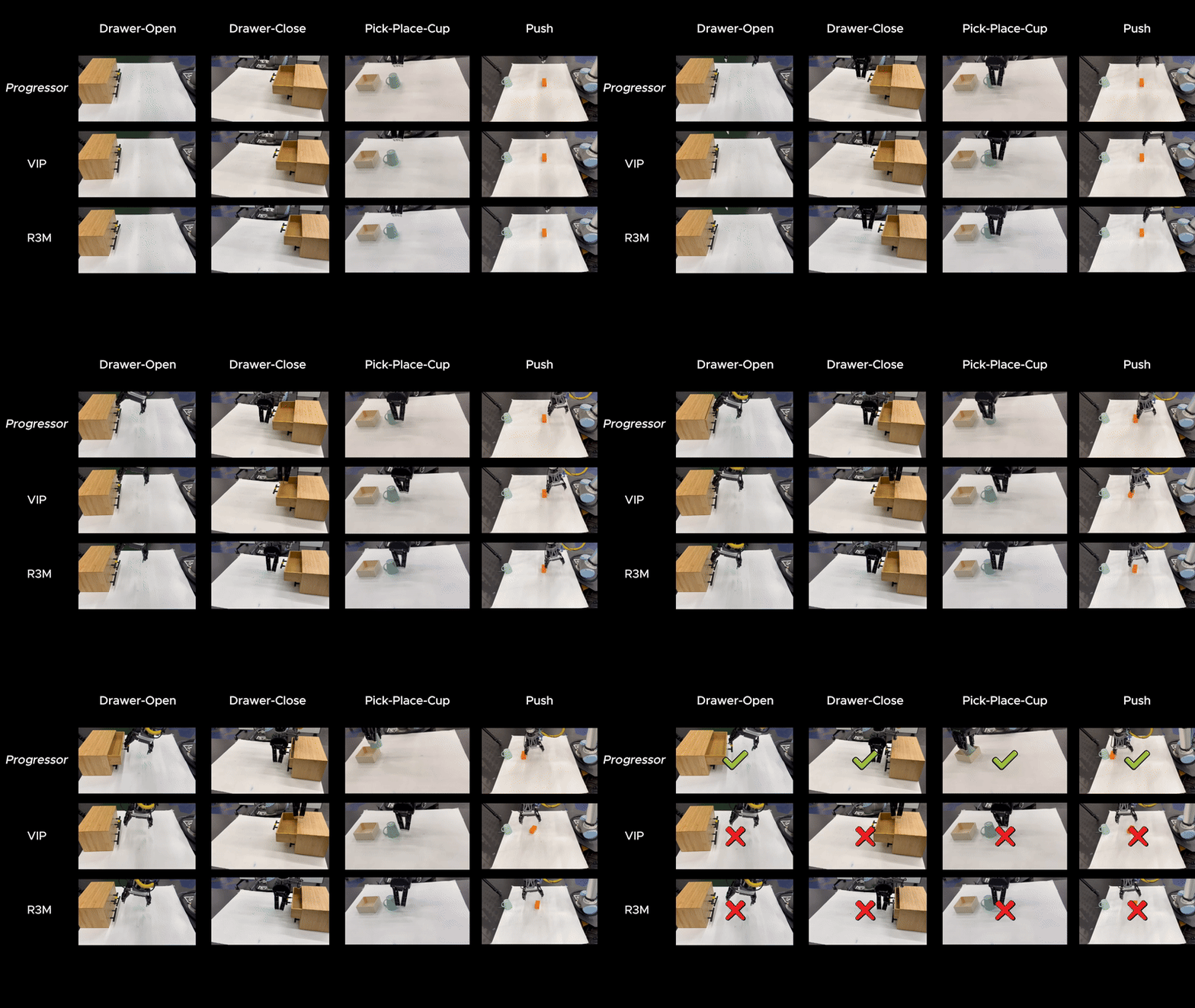
My research focuses on world models and latent actions learned from diverse, unlabeled video, with reward learning from visual observations as a complementary thread. In CLAW, I jointly learn a diffusion-based world model and continuous latent actions end-to-end from action-free video; the resulting model supports imitation from observation and goal-directed planning, and I evaluated it on a real UR5 with pretraining on human video (e.g., 43% RoboDesk upright-block planning vs. 5% AdaWorld). In PROGRESSOR (ICCV 2025), I learn a self-supervised visual progress reward with online refinement for robot RL without manual reward design. I also co-authored a CoRL 2026 Oral on what robot manipulation benchmarks actually measure. I am interested in scaling these directions beyond curated datasets toward in-the-wild visual experience.
Prior to my PhD, I earned an M.Sc. in Computer Science from the University of Saskatchewan, where I worked with Dr. Ian Stavness on unsupervised computer vision.
I am seeking Summer 2027 research internships in robot learning and world models.
news
| Nov 03, 2026 | Our paper “What Are We Actually Benchmarking in Robot Manipulation?” has been selected as a Best Paper Award finalist at CoRL 2026! 🎉 |
|---|---|
| Nov 03, 2026 | Our paper “CLAW: Learning Continuous Latent Action World Models via Adversarial Latent Regularization” has been accepted to the CoRL 2026 Workshop PhysWM! 🎉 |
| Oct 01, 2026 | Our paper “What Are We Actually Benchmarking in Robot Manipulation?” was accepted as an oral at CoRL 2026, and received the Best Abstract Award at the IROS 2026 Workshop on Reproducible Benchmarking of Robotic Grasping and Manipulation! 🎉 |
| Aug 31, 2026 | Our paper “CLAW: Learning Continuous Latent Action World Models via Adversarial Latent Regularization” was selected for a lightning talk at WM@Booth 2026! 🎉 |
| Jun 11, 2026 | I gave a talk on “CLAW: Learning Continuous Latent Action World Models via Adversarial Latent Regularization” at the Midwest Robotics Workshop (MWRW) 2026! 🎉 |
| Jun 26, 2025 | Our paper “PROGRESSOR: A Perceptually Guided Reward Estimator with Self-Supervised Online Refinement” is accepted at ICCV 2025! 🎉 😊 |
| Feb 10, 2025 | Our paper “Enabling End Users to Program Robots Using Reinforcement Learning” has been accepted at HRI 2025. |
| Nov 26, 2024 | Our paper “PROGRESSOR: A Perceptually Guided Reward Estimator with Self-Supervised Online Refinement” is now available on Arxiv. |
| Jun 15, 2021 | Our paper “Automatic Microplot Localization Using UAV Images and a Hierarchical Image-based Optimization Method” has been published in Plant Phenomics. |
| Aug 28, 2020 | Our paper “Unsupervised Domain Adaptation for Plant Organ Counting” received the Best Paper Award in CVPPP at ECCV 2020! 🎉 😊 |
selected publications
- PhysWMCLAW: Learning Continuous Latent Action World Models via Adversarial Latent RegularizationIn CoRL Workshop PhysWM, 2026Takeaway: end-to-end continuous latent actions + diffusion world model from action-free video; 43% RoboDesk upright-block planning vs. 5% AdaWorld; 1.7/3.0 long-horizon real UR5 vs. 1.5 AdaWorld.
- PROGRESSOR: A Perceptually Guided Reward Estimator with Self-Supervised Online RefinementIn Proceedings of the IEEE/CVF International Conference on Computer Vision (ICCV), 2025Takeaway: self-supervised visual progress reward with online push-back; Meta-World RL without env reward; real-UR5 few-shot offline RL under noisy demos.
- What Are We Actually Benchmarking in Robot Manipulation?In Proceedings of the Conference on Robot Learning (CoRL), 2026Takeaway: four diagnostics showing popular manipulation benchmarks often fail as proxies for general capability; reference implementations released.
-
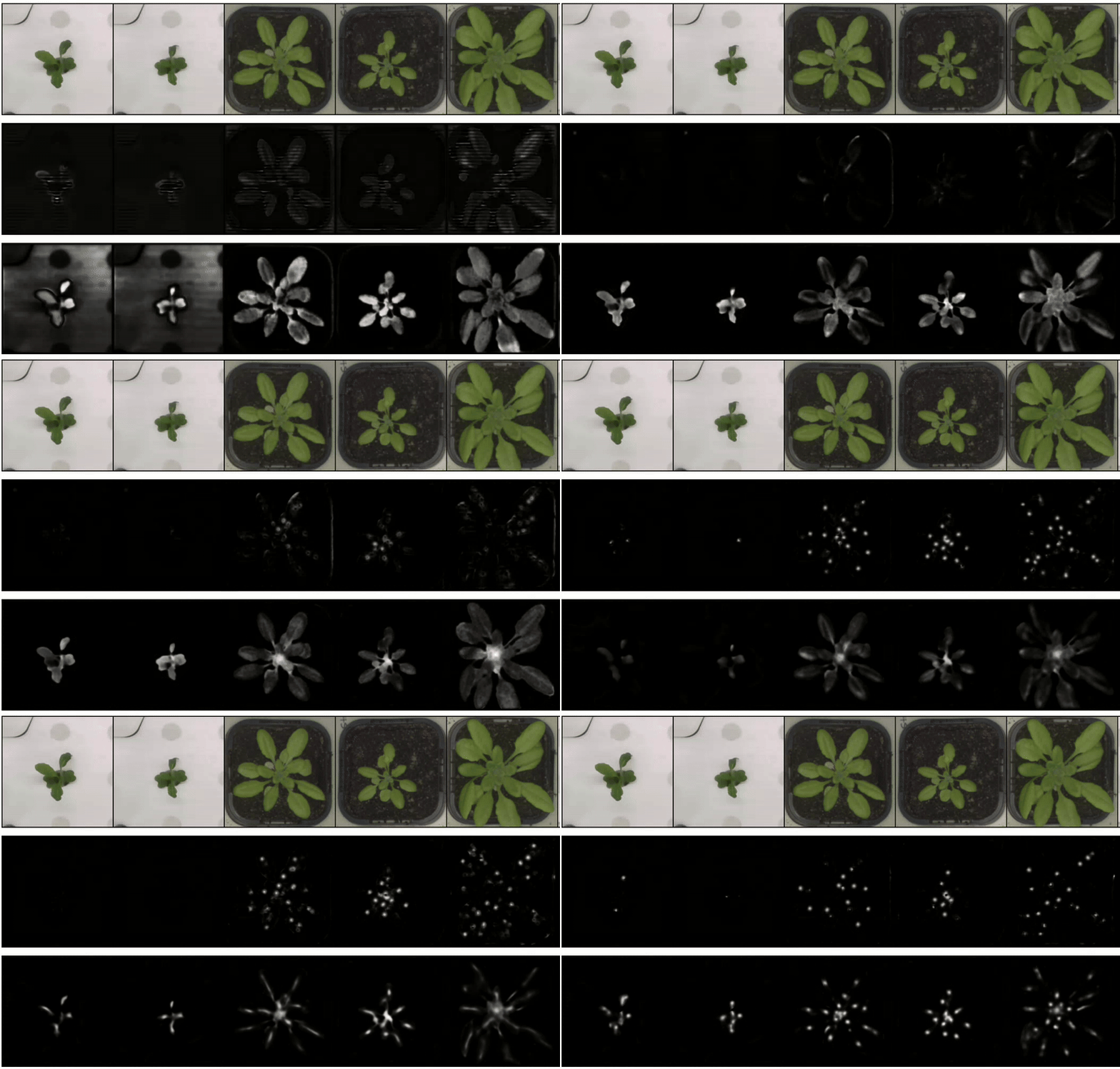 Unsupervised Domain Adaptation for Plant Organ CountingIn Proceedings of the European Conference on Computer Vision (ECCV), 2020